


Indigenous Plant Garden at the Downtown School Farm
Location: Sḵwx̱wú7mesh / Squamish, British Columbia.
Map Coordinates: 49.704781, -123.149988 (between Howe Sound Secondary & Squamish Elementary)
The Indigenous Plant Garden space is for all students and community members to relax, reflect and connect with Indigenous plants, while learning the cultural significance and pronunciation of them in the Sḵwx̱wú7mesh language.
We are thankful to many folks who supported and guided this work, which include:
Sḵwx̱wú7mesh Úxwumixw Elders, and Leigh Joseph (Styawat), Ethnobotanist.
Teachers, staff and students from Howe Sound Secondary (Heather Lafreniere, Indigenous Leadership class 23/24, Jasmine Baker (Długwa̱la), Erin Eidsvik, Farm Studies class 23/24, John Hamill, Colleen Hannah and Tami Jazic)
Youth Climate Corps British Columbia (Nicole Kilistoff, Aida Goma Petit, Michela Phillips, Keenan Miles and Will Cote.)

About the Translator
My name is Jasmine Baker and my Ancestral name is Długwa̱la (Glue-gwa-la). I come from the Sḵwx̱wú7mesh and Musga̱maḵw Dzawada̱'enux̱w. One of my dreams is to become an ethnobotanist and I’ve always loved learning the properties of Traditional Medicines.
Listen and practice how to pronounce the plant name in the Sḵwx̱wú7mesh language.

Stsá7tskaý (saskay) - Salmonberry Shoots
Pousses de saumoneaux
Traditional Uses:
-
In spring, Salmonberry shoots (stsá7tskaý) can be peeled and eaten and have a sweet, sugary taste.
-
The leaves can also be dried and used to make teas.
-
The shoots are rich in minerals and vitamin C, as well as a great source of fiber.

Lhásem - Northern Rice Root
Racine de riz du nord
Traditional Uses:
-
Important source of carbohydrates in traditional Indigenous Peoples diets.
-
It has been cultivated in estuary root gardens up and down the coast for thousands of years.
-
They are fly and beetle pollinated and can reproduce vegetatively from the little rice grain bulblets, very quickly.
Caution: This plant should not be wild harvested. Habitat and populations of this plant have been highly impacted.

KáÍkay - Wild Rose
Églantier or Rosier de Nootka
Traditional Uses
-
Petals can be eaten fresh and added to salads or made into jam.
-
The petals can be made into tea, which is also used as an eyewash.
-
The rose hips are known to be very high in vitamin C and are used to make fruit leathers, jams, and jellies.
-
The fruit is antimicrobial and a diuretic.
Safety Cautions
-
The hairy seeds inside the rosehips should not be eaten. They irritate the digestive tract.

Ch’átyaý - Devil’s Club
Aralie épineuse or Bois piquant
Traditional Uses
-
It is very culturally and spiritually significant to Indigenous cultures.
-
The stalk should be processed when fresh.
-
It possesses anti-inflammatory and antibacterial properties.
-
You can use the bark (very sparingly) in a tea.
Cautions:
-
This is a very powerful medicine. It should only be harvested and used with guidance from someone that is knowledgeable about the plant.

KwiÍayus - Red Flowering Currant
Groseille à fleurs rouges
Traditional Uses:
-
This plant is used as food within a feast, as well as in herbal tea.
-
Medicinally, it is used for colds and flu, and as an eyewash for sore eyes.

Si7semáchxw - Yarrow
Achillée
Traditional Uses:
-
Yarrow plant posses anti-inflammatory properties.
-
Chewing the leaves can alleviate toothaches.
-
The leaves can be steeped in a tea to calm an upset stomach.
-
Dried yarrow leaves can be made into a powder to stop bleeding.
-
It can also be used as flavouring when cooking.
-
The dried leaves and flowers can be used in a bath to calm irritated skin.
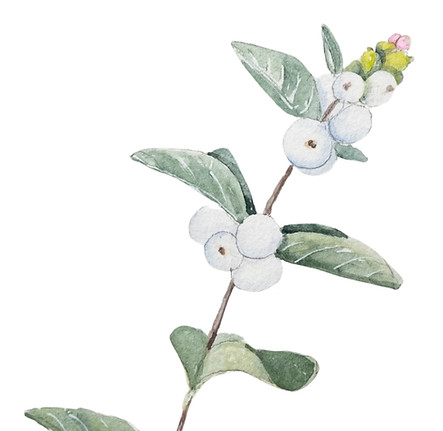
Ts’ex̱wts’x̱wáy̓ - Snowberry
Symphorine
Traditional Uses:
-
The bark can be used to treat swimmer’s itch and in a salve to help treat severe burns and nerve damage.
-
The shoots can be stripped and used to make a broom, for cleaning.
Caution:
-
DO NOT eat the berries! They are poisonous.

Yetwánaý - Salmonberry
Baie de saumon (Ronce Remarquable)
Traditional Uses:
-
The red and orange berries can be used as fish bait
-
Nutritious food rich in minerals and Vitamin C and source of fiber in diets.
-
The berries can be yellow to orange to red and they are juicy and best eaten fresh.
There is a belief that the song of the Swainson's thrush ripens the salmonberries and signals when they are ready to harvest.

Kweláwa - Nodding Onion
Ail penché
Traditional Uses
-
This entire plant is edible.
-
The bulbs of which can be used like an onion.
-
When prepared, it is often cooked in a pitcook.
-
The leaves can be made into a poultice to help with congestion.
-
Overall this plant can support a healthy immune system.

Schi7iáý - Wild Strawberry
Fraise
Traditional Uses
-
The leaves can be used for a facial toner or facial steam.
-
If used in creation of a tea, it eases a sick stomach and can prevent colds.
-
It is also used as a sweetener for bitter medicines.
Indigenous Plant Guide
The Pacific Northwest is the most biodiverse region in Canada. Local Traditional Ecological Knowledge (TEK) relating to Indigenous plants is extensive with more than 145 species utilized by members of the host nations for technology, food, medicine and ceremony.
This page spotlights a few of these plants, found growing in the Indigenous Plant Garden at the Squamish Downtown School Farm, in Sḵwx̱wú7mesh sníchim , the language spoken by the Musqueam, Squamish and Tsleil-Waututh communities. We thank them for sharing some of their knowledge with us.
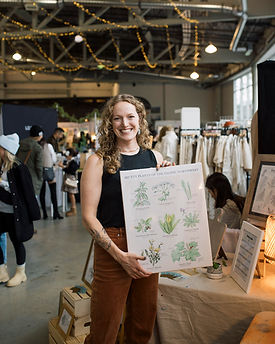
Get to know the Illustrator
Sarah Keller, born in Kelowna, BC, developed a deep love for the outdoors through her family's garden and camping trips in BC Parks. After moving to Vancouver to study Kinesiology, the Coastal Temperate Rainforest shifted her focus to algae, fungi, and ecology. Now an elementary school teacher, Sarah fosters curiosity about nature and human connections to the environment.
Her work was featured in Vancouver is Awesome and The Squamish Chief for her ‘Sh*tty Plants of the Pacific Northwest’ poster. She lives in Squamish, where she enjoys painting, hiking, and exploring with her partner and dog.
The Collaboration
Sarah was commissioned to bring her watercolor style to convey the beauty of the student-designed Indigenous garden. Sarah has been a champion of the school farm project and continues to provide hands-on experiential learning to her students.
Sarah is fascinated by plants and wild things, and especially how humans interact and care for them. This passion led her to become a teacher. She currently teaches elementary students in order to help them foster the same curiosity that she has for being human, enjoying plants and finding out what may be hiding under rocks.
Her illustrations are featured on the interactive signage at the garden, as well as above, within the plant guide.
Learn more about Sarah here: Sarah Keller Art

Our Sponsors


Building the Indigenous Garden
The Indigenous Garden is a living testament to community collaboration, cultural resilience, and the power of hands-on learning. Created through deep partnership with Indigenous community members, educators, and volunteers, this space honours Indigenous knowledge, local plant wisdom, and the hard work of many hands who helped bring it to life. It stands not only as a garden, but as a gathering place and an ongoing act of reconciliation.
See the garden come to life in our build blog with photos.

Educators take an interdisciplinary approach with lots of hands-on learning opportunities for their students and community members.
To expand and encourage sustainable agriculture and food production in our region
We bring together organizations, businesses, government representatives and community groups, to share perspectives and address challenges in our local food system.